

Public Private Partnerships Encourage Deceptive Lawmaking
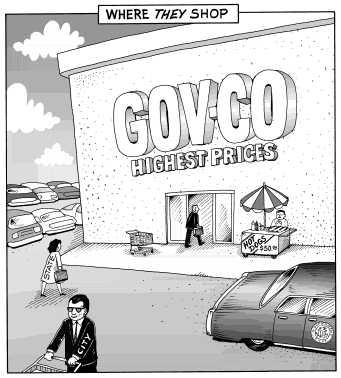 Public-Private Partnerships (P3s) are being touted by an increasing number of politicians, corporations and think tanks as the new way to support the U.S. infrastructure, such as roads, airports and water. What many people may not know is that the corporations participating as the “private” entity in public-private partnerships also donate millions of dollars to political campaigns through PACs, corporate and individual donations.
These corporations influence state lawmaking through private meetings and weekend retreats with state legislators. The outcome of those meetings is that lawmakers come away with model legislation (templates of sample bills) as well as talking points and guidance for how to “sell” certain desired initiatives to the public. Often when we, the public, learn about a new bill we assume that the legislator sponsoring the bill came up with the proposal based on input from constituents, or perhaps on their own or in collaboration with other lawmakers. Most of us do not realize that frequently these bills are actually generated by corporations and their lobbyists and lawyers trained in bill writing and the legislative process.
Proponents of free market economics typically oppose P3 tolling since the practice shackles citizens with 50-75 year contracts with corporations for projects that are propped up by taxpayer dollars. Those who have fought toll lanes in other states, and many are conservatives, report that the Republican-oriented ALEC organization is not serving the public’s interests by lobbying legislators in secret meetings to contract out America’s roads to private tolling companies. Even if you agree with some of ALEC’s initiatives, it should still be disconcerting that they do not disclose their corporate or legislative members and that they provide model bills to legislators without our knowledge. Here is their declaration on tolling: http://www.alec.org/model-legislation/alec-statement-of-principles-on-toll-roads/).
In the case of toll lanes where a corporation is the private partner that builds and operates the toll lanes, legislators are instructed by corporations and their experts about how to pass legislation that makes collecting tolls by a private company legal. This is frequently referred to as P3 legislation. Once the P3 legislation becomes law, it is often then the lawmakers’ task to influence local leaders to adopt the toll lane plans. While public hearings are held, as many cities will report, the public’s disapproval is usually ignored. Perhaps for some politicians, the hundreds of thousands of dollars in donations by all the corporate entities involved in a P3 infrastructure project could outweigh the downside of discontent voters.
Another reason a lawmaker could remain bent on a project despite overwhelming public opposition could be that he or she was appointed as the “project champion”. Concern about letting down the corporations and more powerful government authorities pushing for the project could lead a lawmaker to “dig in their heels.” A powerful legislator who can easily hold sway over local leaders is usually selected as a project champion. A guidebook by the FHWA states, “Garnering support from one or more public figures can be one of the most instrumental factors in garnering support for a priced managed lanes project or its implementation. A project champion may be an elected official, a community leader, or private sector leader who effectively communicates an individual or organizational rationale for supporting the project.” See section 4.3 in the FHWA’s Priced Managed Lane Guide: http://www.ops.fhwa.dot.gov/publications/fhwahop13007/pmlg4_0.htm#43 (Ironically, this document was authored in part by NC’s so-called consulting firm, Parsons Brinckerhoff, who just so happens to be in the tolling business.)
When lawmakers collaborate with private organizations and corporations behind closed doors, the citizens are left out of decision-making and are kept in the dark as to who and what is motivating a project and legislative changes. Corporations can then continue to capitalize on public-private partnerships as a boondoggle, while politicians become brokers for corporate interests that pad campaign coffers. The result for us citizens is that not only are we deceived by our own legislators who are no longer serving our best interests, but then for decades we are forced to dole out big bucks for essential public services contracted by our government at inflated prices.
Please contact your legislators to encourage them to gather ideas and solutions from their constituents and those with objective perspectives, and not from corporations with ulterior motives.
 We need your help! If you like PunditHouse, please consider donating to us. Even $5 a month can make a difference!
Short URL: https://pundithouse.com/?p=14312
