

America: At the Fork Of Hayek’s “Road To Serfdom”
Click to Purchase
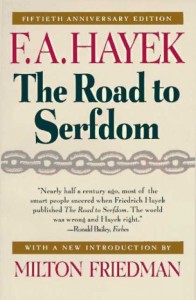
Austrian economist Friedrich Hayek’s landmark work entitled “The Road To Serfdom” was published originally in 1944 as World War II entered what Churchill would have called “the beginning of the end,” even though months of devastating, destructive, and costly war still lay ahead. Just as the allied and the axis powers battled for military supremacy, so too the academicians of the day lofted volley after volley at each other analyzing the forms of and the proper roles for governments. And the examples of the day could not have been more revealing…Totalitarian Germany, the Communist Soviet Union, the emerging Labor Government in Great Britain, and the Democratic Republic of the United States represented the entire spectrum of governmental possibilities. In Germany, the fascists who, mesmerized by the flair and propaganda of their new leader Adolph Hitler, had seized control of the government years before along with the means of production for the society, had now embarked on a “Final Solution” that involved murdering millions of citizens. In the Soviet Union, the Communists, also by force, had seized control of the government and the means of production, but under the guise of creating a worker’s paradise for the proletariat. And in the United States, with our government of the people, by the people, and for the people with inalienable rights conferred by God as detailed in our Constitution, the world’s emerging preeminent economic and military power continued to sacrifice her sons and daughters in defense of freedom around the world. It is in this environment that Hayek analyzes the various forms of government and, most importantly, does so in his capacity as an economist with knowledge of capitalism, market competition, and their opposite, central planning. “The Road To Serfdom” is a timeless treasure of truths and is a must read for all students of history, economics, and political science as it provides a basis for understanding how a nation’s governmental structure and policies can and do impact the freedoms and liberties of it’s citizens as well as the economic prosperity those citizens can strive for.
Hayek’s Warning and Purpose
Hayek’s words bear repeating here, especially in light of the financial condition and political environment in which we Americans find ourselves. He states that “If few people in the Western world now want to remake society from the bottom according to some ideal blueprint, a great many still believe in measures which, though not designed completely to remodel the economy, in their aggregate effect may well unintentionally produce this result.”1 Continuing he states “That hodgepodge of ill-assembled and often inconsistent ideals which under the name of the Welfare State has largely replaced socialism as the goal of the reformers needs very careful sorting out if its results are not to be very similar to those of full-fledged socialism.”2 And most pertinently Hayek continues “Just because in the years ahead of us political ideology is not likely to aim at a clearly defined goal but toward piecemeal change, a full understanding of the process through which certain kinds of measures can destroy the bases of an economy based on the market and gradually smother the creative powers of a free civilization seems now of greatest importance. Only if we understand why and how certain kinds of economic controls tend to paralyze the driving forces of a free society, and which kinds of measures are particularly dangerous in this respect, can we hope that social experimentation will not lead us into situations none of us want.”3 Hayek fully understood that the loss of individual freedom and liberty, and the abandonment of free markets and competition and capitalism moved the people toward the mediocrity and malaise of socialism and worse and that a government that could promise anything to anybody was imposing enough to take anything from anybody.
Economic Developments In Europe
In the decades prior to the German and Soviet revolutions, the economies of European countries, especially, developed where men were free to pursue objectives on their own where there was no government to stifle their efforts…discoveries in science flourished and entrepreneur’s efforts led to the industrial revolution. Thereafter, freedom, and the success it spawned came to be viewed despairingly as the socialists of the day pointed out that democracy and capitalism could only offer a share in the common progress…that sharing in economic success was not a given, just the opportunity was. Lost in their argument was the fact that freedom of individuals to pursue their dreams with diligence and hard work had given rise to the economic success in the first place. As Hayek puts it, “And, as the hope of the new generation came to be centered on something completely new, interest in and understanding of the functioning of the existing society rapidly declined; and, with the decline of the understanding of the way in which the free system worked, our awareness of what depended on its existence also decreased.”4 Or said another way, those who campaigned against individual freedom and liberty forgot that it was just that concept that was the goose who had laid the golden egg. ..socialists changed the meaning of the word “freedom” from the absence of government control to mean the absence of having to strive for life’s necessities such as food and lodging. And thus the battle between democracy, individual freedom and liberty versus socialism, communism, fascism, and government control was enjoined.
Socialistic Utopia Never Materializes
Hayek notes that in Europe, just as in Asia and in other countries where it has been tried, the promised socialistic utopia never materializes….and the reason is control. Governments in socialistic countries must exert ever increasing control over their subjects to insure the needs of the society are met. In democracies with capitalism, market competition and prices are used to manage the supply and demand of goods and services whereas in a socialist economy, it is the planners who determine this. Markets for the unending variety of goods demanded by the public is far too complex a working to be managed by planners and hence, in socialist countries, the variety of goods and services becomes limited. Hayek quotes the American journalist and author Walter Lippmann as stating “the generation to which we belong is now learning from experience what happens when men retreat from freedom to a coercive organization of their affairs. Though they promise themselves a more abundant life, they must in practice renounce it, as the organized direction increases, the variety of ends must give way to uniformity. That is the nemesis of the planned society and the authoritarian principle in human affairs.”5
The Rule of Law
While one might think that Hayek had covered quite enough in “The Road To Serfdom” in discussing forms of government, central planning, capitalism, and free markets, he adds a discussion of perhaps, to Americans today, the most critical issue ….the Rule of Law. This is the concept that government is bound in its actions by fixed rules that are known beforehand and that , being known, citizens can plan their actions and activities on the basis of these rules. With a Rule of Law, governments are prevented from interfering in an “ad hoc” fashion with their actions.6 Hayek argues that “If we want to create new opportunities open to all, to offer chances of which people can make what use they like, the precise results cannot be foreseen. General rules, genuine laws as distinguished from specific orders, must therefore be intended to operate in circumstances which cannot be foreseen in detail, and therefore, their effect on particular ends or particular people cannot be known beforehand.” 7 In other words, Hayek makes the case for general laws that do not knowingly discriminate against any group or person and of course, for as free markets as possible while fully acknowledging that society must have enforceable laws with which to function. In perhaps the most critical and poignant statement in the book, Hayek declares that “by giving the government unlimited powers, the most arbitrary rule can be made legal and in this way a democracy may set up the most complete despotism imaginable.”8
America Today
Moving forward from the time of Hayek’s writing(1944) to today is a sobering trip. The ideals espoused in the United States Constitution, our supposed Rule of Law, to limit the federal government and to preserve individual freedom have been ignored leaving only a faded document residing in the National Archives. Politicians have used the tax code to redistribute income to the point that a full 40% of Americans are outside of the federal tax system while those who do pay federal taxes have seen the number of days to pay their federal taxes grow from 8 days of work in 1900 to roughly 76 days today. This means that citizens have lost a full 25% of their work year to the federal government’s income redistribution efforts. Hayek could not have been more correct that this phenomenon would happen slowly over time. Our federal government, who’s defined role was theoretically to be that of only defending the country and not much more, has now morphed into an income redistribution agent taking resources from citizens to pay for the healthcare, food, housing, retirement and mortgage relief needs of other citizens. The federal government in now engaged in a great debate to take over the nation’s health industry…a move that would add another $2 trillion dollars to the size of the government and would nationalize a full one-sixth of the national economy. And in perhaps the cruelest slight of hand, politicians have not included the unfunded mandates for Medicare, Medicaid, and Social Security in the nation’s budget. These “off-budget” future planned expenditures total over $45 trillion dollars and, the Congressional Budget Office(CBO) projects, will have a devastating effect on the economy of our country. Individual tax rates that are currently 25% will need to rise to 63% just to pay for these programs and corporate tax rates that are now 35% will need to rise to 88%. 9 And so along with state taxes and fees, Americans, by the year 2080, will be working most of the year just to pay federal taxes.
American Socialism Realized?
And so, yes, America has reached the fork in the road to serfdom and socialism that Hayek warned about decades ago. Government doesn’t need to own the means of production in order to control society and thereby qualify as a socialized government, they can simply tax and legislate citizens and businesses to the point that they have “defacto” control over the resources and products that are produced. In America, the Constitution is no longer functioning as our Rule of Law and Hayek’s warning of “a democratic government with unlimited powers becoming authoritarian” 10 is coming to pass. But there is still hope. The same flame of yearning for freedom and liberty from tyrannical government that led to the American revolution, that has simmered for years, is beginning to burn brightly anew. The years ahead will tell whether the American spirit of freedom is ingrained in this generation as it was in generations before and will tell, in fact, if America is truly a country with a government of the people, by the people, and for the people.
Notes:
1. Friedrich Hayek, “The Road To Serfdom,” 1944.
2. Ibid.
3. Ibid.
4. Ibid.
5. Ibid.
6. Ibid.
7. Ibid.
8. Ibid.
9. Peter R. Orszag, Director, Congressional Budget Office, Letter to Representative Ryan, (R-WI), May 19, 2009.
10. Friedrich Hayek, “The Road To Serfdom,” 1944,
 We need your help! If you like PunditHouse, please consider donating to us. Even $5 a month can make a difference!
Short URL: https://pundithouse.com/?p=1039
