

Snowballs of Secession
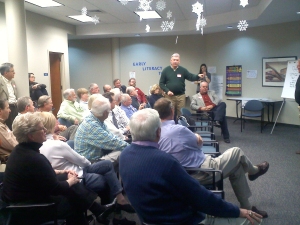 A group of about 40 residents from south Mecklenburg, including County Commissioner Bill James and City Councilmember Warren Cooksey, huddled this week to discuss the possibility of Ballantyne and a swath of suburbia breaking from Charlotte to form its own city.
And folks from Mecklenburg’s southern suburbs, it turns out, aren’t the only ones contemplating the prospect of a break-up. Echoes of a previous secession movement of sorts, when residents and political leaders from north and south Mecklenburg led an unsuccessful effort to split from Charlotte-Mecklenburg Schools to form independent school districts, are once again making the rounds.
The gathering Wednesday night at the South County Regional Library was held part and parcel of a burgeoning grassroots group called South Meck Alliance Responsible Taxpayers (SMART), which was recently formed to “give voice to the neglected and exploited taxpayers of South Mecklenburg,” according to the group’s mission statement. Ideas for its official logo, still under design, include a swirl of dollar bills being sucked into an abyss that sports Charlotte’s uptown skyline.
While discussion at the SMART meeting touched on everything from tax burdens to developing a unique identity for south Mecklenburg and increasing suburban voter turnout, the undercard topics set the stage for the main event: should, or even could, Ballantyne and some of its suburban neighbors break from Charlotte to form their own potentially not-so-mini metropolis?
“What I heard tonight wasn’t enough to justify forming a new city,” said Cooksey, whose city council district includes Ballantyne. But that doesn’t necessarily mean he thinks it’s not an idea worth pursuing.
“I don’t have an official position yet, but I’m looking at the process,” Cooksey said. “I haven’t been doing this research because I think it’s a bad idea.”
James, whose county commission district includes parts of south Charlotte and the towns of Matthews and Pineville, was less circumspect.
“We’re getting robbed,” he said of the taxing relationship between the southern suburbs and the city. “We’re basically a deep pocket to help pay for social programs and trinkets that benefit uptown. We have no say in policy or how they spend our money. That needs to change and this is the most direct and effective way to do it.”
That sentiment was voiced by several other speakers who shared frustrations of sending big tax dollars to city coffers, they said, while receiving little in return. But not everybody was sold on the idea of breaking from Charlotte, at least not yet. An informal show-of-hands vote on the concept yielded about a 70/30 split favoring a new city.
“I know we’re a cash cow, and that stinks. But revolution seems a bit dramatic,” said one speaker. “I haven’t heard a compelling reason why we can’t or shouldn’t remain a part of Charlotte.”
Tim Timmerman, a south Mecklenburg resident who helped lead the SMART meeting, said he didn’t expect complete agreement on the prospect of splitting from the city. The purpose of SMART, he said, is to gather ideas and plans, opinions and options for moving forward.
“It’s like a rolling snowball right now,” he said. “We want it to grow bigger and bigger with people adding their support to it.”
Enhancing community identity, local control, and best use of tax dollars could be accomplished by suburban towns forming their own school districts, said Tom Davis, a political activist from north Mecklenburg who helped to lead the CMS deconsolidation movement in 2005. That was quashed when backers of the idea failed to gain enabling legislation and support from state lawmakers.
Davis said the landscape in Raleigh is more favorable now, and that overtures have already been made to explore the possibility of breaking CMS into three independent school districts: north, central, and south. Davis, a retired strategic planner for the U.S. Air Force, declined to give specifics.
“One thing I learned as a strategic planner,” he said, “is that you don’t let people know the details of your plans until you’re ready to use them.”
In a similar vein, the water is already being tested in Raleigh to gauge support for the Ballantyne split. Sen. Bob Rucho, a Republican who represents the area, has said he is open to exploring the idea.
It would, however, likely be “an extraordinary uphill battle,” Cooksey said. State law prohibits creating a city out of an existing city, he said, and special enabling legislation would be needed to include a three-fifths vote of support in both chambers of the General Assembly, versus a simple majority. Hammering out specifics and agreements for payments on already-approved city bonds that fund infrastructure in the Ballantyne area would also be required, he said.
“You can’t swipe 80,000 to 100,000 people out of Charlotte’s population without factoring in bond debt,” Cooskey said. “If you’re going to create a new city, you can’t do it by destroying Charlotte.”
A host of interlocal agreements for services like public safety and utilities would also be necessary for a new city, at least initially, Cooksey said. When you factor in all the those costs, he said, the new city would likely have a tax rate comparable to Charlotte’s existing rate of 43-cents per $100 valuation.
James offered a different take.
“I don’t know what the (tax) rate would be,” he said, “but I have a hard time believing it would be more than what Charlotte is bleeding us for now.”
Whether a new city – a moniker of Providence is already being floated as a possibility – ever comes to fruition, Timmerman said he hopes dialogue and discussion about the idea leads to improved relations between Charlotte and its suburban communities.
“If Charlotte wants to survive and not become Detroit,” he said, “it had better wake up and start taking care of the suburbs.”
 We need your help! If you like PunditHouse, please consider donating to us. Even $5 a month can make a difference!
Short URL: https://pundithouse.com/?p=8306
