

CATS Scratching For Big Bucks
(Photo: City of Charlotte)
As the federal government sinks into a growing abyss of debt that has drawn rebuke from Standard & Poor’s rating agency with a national credit downgrade and calls for reduced spending, the Charlotte Area Transit System is seeking upwards of $63 million in grant funding from the U.S. Department of Transportation.
If the grant applications are met with success, however, it’s uncertain if the Charlotte City Council will approve accepting the federal largess, which requires substantial matches in local funding.
As part of it strategic objective to increase transit revenue by responding to so-called “Notices of Funding Availability” offered by the U.S. DOT, local transit officials are pursuing multiple projects in hopes of securing a sizeable chunk of the more than $1 billion up for grabs in federal grant money.
The city council is slated on Monday to review two CATS grant applications for projects that total nearly $11 million, with $9.7 million coming from federal grants and $1 million from local funding, with a request that the N.C. Department of Transportation cover half of the local match.
CATS is submitting a proposal for $5 million of federal grant money that would add six hybrid buses to its fleet, replacing diesel buses that transit officials say “have reached their useful life.” Another $5.8 million in federal money is being sought under a Clean Fuels grant, which would fund eight new hybrid buses and 10 lightweight buses for CATS Special Transportation Service. Both types of vehicles will replace current buses, transit officials said; the lower-weight buses, officials said, are designed to reduce fuel consumption.
Councilmember Patsy Kinsey, a Democrat who sits on the council’s transportation committee, said she hasn’t had a chance to review CATS’s grant proposals in detail, but is leaning toward supporting them if the costs can be justified.
“My general feeling is that if [the grants] are being offered, we ought to apply,” Kinsey said. “I don’t think CATS would be applying if they didn’t think we could afford it.”
In addition to the Clean Fuels grants, CATS is also pursuing nearly $12 million of federal money, with a local match of $2.9 million, to implement the transit system’s Sprinter bus expansion to the Central Avenue and Beatties Ford Road corridors.
The project would not impact existing operating costs, according to CATS officials, because current bus routes in the targeted corridors would be transferred to the expanded service area. The majority of expense would be for the purchase of 13 hybrid electric buses, which transit officials said would offset the replacement cost of diesel buses already included in CATS’s capital improvement program.
As part of the State of Good Repair Program grants being offered by the federal government, CATS is submitting four proposals totaling $16.8 million:
~ Fare Box Replacement ($5.8 million of federal grant money; $1.4 million of local funding provided by CATS and NCDOT) The project would replace the farebox system for all of CATS’s 323 fixed-route buses. The project would also “introduce fare media validation on the Special Transportation Services paratransit system,” according to a CATS memo to city council. “Current customers of this service are compelled to use paper tickets and passes … The new system would improve the boarding experience for these customers, many of which have manually dexterity issues.”
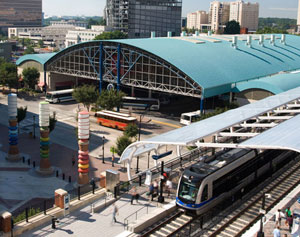
~ Charlotte Transportation Center Upgrades ($1.4 million of federal grant money, matched with $300,000 of local half-cent sales tax revenue) The project would replace an air conditioning unit, add additional storage capacity, improve the storm drainage system, renovate restrooms, and replace and upgrade canopy outdoor lighting with energy efficient lighting.
“Virtually all of the major mechanical assets [of the transportation center] are near or beyond their useful life, and beyond their effectiveness given the high-density component, extended hours of operation and servicing greater than double the capacity of the original design,” according to CATS’s memo to city council.
~ Bus Radio/Console Replacement ($2.4 million of federal grant money; $600,000 of local half-cent sales tax revenue, with CATS requesting that NCDOT cover half the local match) The project would replace CATS’s 565 analog radios/consoles with units that are digital capable. CATS’s current radio system has become cost-prohibitive because of high vendor pricing and out-of-warranty support, according to transit officials.
~ Automatic Vehicle Locators/Automatic Passenger Counter Replacement-Upgrade ($3.9 million of federal grant money; $900,000 of local half-cent sales tax revenue, with CATS requesting that NCDOT cover half the local match) CATS uses its automatic vehicle locators and passenger counters to identify high performing and underperforming routes.
CATS is also pursuing $15 million to $27 million as part of its application for a Transportation Investment Generating Economic Recovery (TIGER) grant, an offshoot of the Obama Administration’s massive American Recovery and Reinvestment Act. The TIGER grant would be used for the LYNX Blue Line South Corridor Phased Retrofit project. Phase One of the project would upgrade the light-rail corridor’s power components to support three-car trains. The project’s second phase, which CATS officials said is optional and depends on the size of grant received, would extend the Blue Line’s passenger platforms at the I-485, Stonewall and Seventh Street stations to accommodate three-car trains.
Republican Councilmember Warren Cooksey, a member of the council’s transportation committee, has a history of voting against accepting federal stimulus money, even for projects that would have benefited his district. Cooksey said he would likely maintain that position by voting to not accept any grant money landed by CATS that has its fiscal roots tied to American Reinvestment and Recovery Act.
Cooksey has previously voted to accept federal grant money made available through general notices of funding availabilities and pursued by city departments.
“As much as I dislike it,” he said, “my previous line was that it’s our tax money too and I’d rather it ended up here than go somewhere else.”
That line might be changing if CATS’s latest round of grant applications is successful.
“With this latest crisis and the federal government’s growing debt, I’ve been coming closer to rejecting it all,” Cooksey said of grant funding. “I think if we had more cities funding these projects on their own, it would make for a stronger system.”
 We need your help! If you like PunditHouse, please consider donating to us. Even $5 a month can make a difference!
Short URL: https://pundithouse.com/?p=7099
